

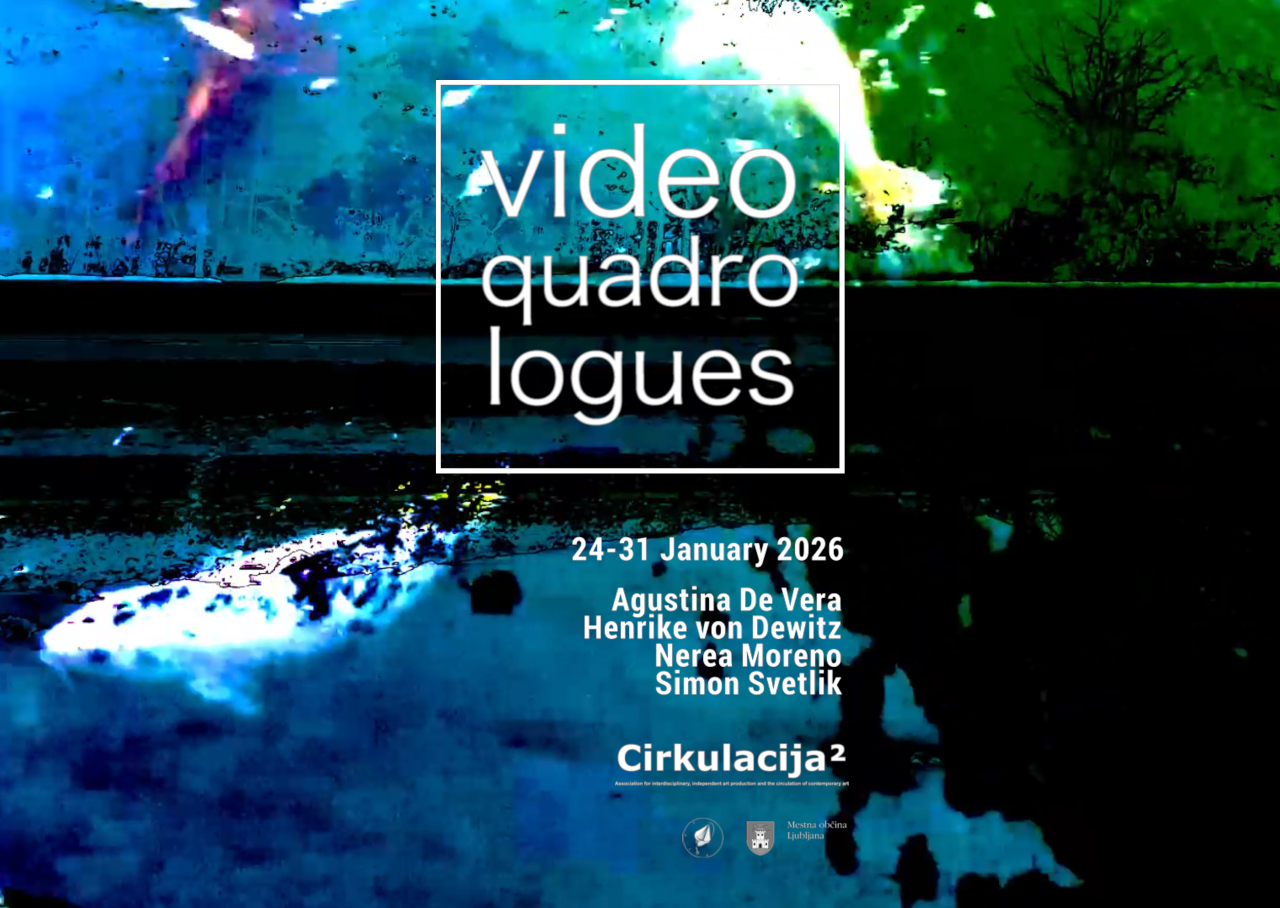
VIDEOQUADROLOGUES
24-31 January 2026
Opening: 24th of January 2026, 8PM
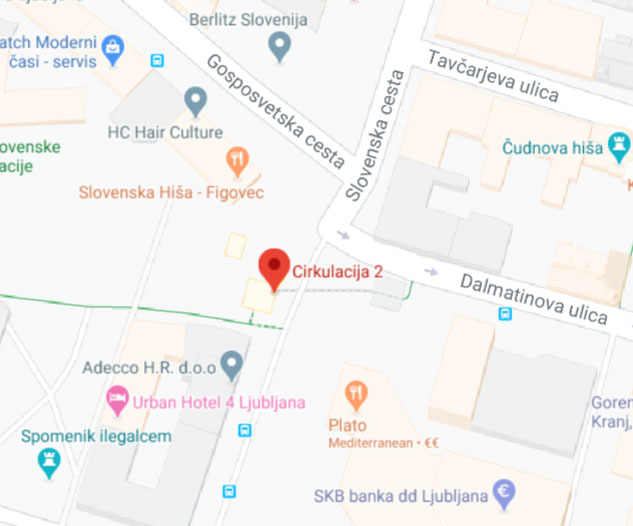
Cirkulacija2 (Podhod Ajdovščina 2), Ljubljana
For almost two years, a group of four artists from different countries and contexts developed a project based solely in the exchange of authorial video material that each one intervened, edited and changed, before passing it to the next one, who would do the same.
This exhibition presents for the first time to the public the results of this video correspondence. A series of collectively created videos from Agustina De Vera (Uruguay), Henrike von Dewitz (Germany), Nerea Moreno Felipe (Spain) and Simon Svetlik (Slovenia) will be displayed in dialogue with fragments from the working process.
Distance and waiting
About the exhibition Videoquadrologues (Agustina De Vera, Nerea Moreno Felipe, Simon Svetlik and Henrike von Dewitz, Cirkulacija2, Ljubljana, 2026)
Francisco Tomsich
There are several (but not many) different models for approaching artistic creation from (or towards) the dissolution of individual authorship. One of the most widely used, since time immemorial, is that which uses technologies of correspondence. In all eras, this implies distance and waiting. I am not referring here to the idea of correspondence between two or more people as a joint work (which it can be), but to correspondence as a strategy, support or condition for the joint creation of a specific object whose characteristics (some of them) are determined in advance according to a common interest.
As A. G. Porta wrote, referring to his collaboration with the Chilean writer Roberto Bolaño, “it is not easy for two persons to create a work in collaboration, as reality confirms”(1). Indeed, the tradition of joint creation is not widespread in literature. It is frequent, though, in painting, architecture, cinema, and the different types of audiovisual languages that we associate with the concept of “video” in order to relate them to the emergence, in the second half of the 20th century, of a type of portable, fast and accessible recording, editing and reproduction technology. On the other side, painting, architecture and cinema have been, or are, eminently collective activities throughout most of their histories. Video, due to its relative youth and the aesthetic context in which it emerged, tends towards individuality. However, it has also always possessed the ideal characteristics to make it a medium for correspondence, and there have been, and continue to be, many examples of video correspondences. Not all of these exchanges, however, are intended as a medium for collective creation that is somehow ‘outside’ the objects being exchanged. Let us pose an example. In the 17th century, two writers living in different countries write letters to each other in which they intersperse verses from a poem they are writing together. The letters are the objects they exchange; the poem is the object they create together using the letters as a medium and which will enter a (literary) system and a distribution circuit. In the 21st century, two visual artists (for example, Simon Svetlik and Henrike von Dewitz) living in different cities (for example, Ljubljana and Izola, in Slovenia) send each other, via the internet, digital video files. They are fragments of the audiovisual flow they produce in their daily lives, but share certain particular characteristics. The artists have realised that what they film, and how they do it, have a lot in common, and have decided to start a dialogue in which these fragments are the objects they exchange in order to jointly create a different object intended to enter an (artistic) system and a distribution circuit.
Simon Svetlik and Henrike von Dewitz exchanged audiovisual files for five years (2018-2023) using a simple method (correspondence involves distance and waiting) and an equally simple methodology: each author receives a file and intervenes in it at will before sending it to the other author, who works on that same file and sends it back. The process goes on until both authors, by mutual agreement, understand that the piece is completed, and they start again with another original material. As in the case of many authors who have gone through similar processes in different artistic languages, their decision to ‘finish’ a piece created in these circumstances has a lot to do with the feeling that the dissolution of authorship has been satisfactorily achieved. Therefore, the phrase “it is now difficult for us to know which of us did what” (which also appears in the testimonies of the artists participating in Videquadrologues) refers to a value and a sought-after or desired result. A result which is not always easy to achieve. I leave it to the reader to draw their own conclusions about the aesthetic, ethical and political implications of this practice.
After two series of exchanges and two exhibitions of the results in the form of video installations that also included fragments of the process, entitled Videopisma (Videoletters)(2), Simon Svetlik (from Ljubljana, Slovenia) and Henrike von Dewitz (from Izola, Slovenia) devoted themselves to “dissolving” in an expanded exchange of correspondence that continued the model previously explored over almost two years (2024-2026) integrating Agustina de Vera (from Montevideo and San José de Mayo, Uruguay) and Nerea Moreno Felipe (from Peralejos de las Truchas, Spain). How this group came together, through what encounters, circuits and coincidences, is a good question to ask the artists participating in Videoquadrologues, who miraculously (considering the enormous distances that separate them and the long waits they have had to endure) have found themselves, for the first time, all together in the same city, preparing and showing the first results of their video correspondence.
The practice developed sui generis by these artists integrates three central aspects that are also a series of decisions made at the beginning of the work process. The first is the method used to carry out the correspondence in an orderly and systematic manner. Each artist produced an original video/audio clip that they sent to one of the other three, who then intervened and sent it to one of the other two, and so on, according to a schedule and with a month’s deadline to fulfil each one´s part. The second aspect refer to the range of strategies and technical procedures applied by each artist as they intervened in the received clips: overlays (of audio and image), distortions, fragmentation, pixelation, inversions, colour layers and numerous other digital video and sound editing effects were applied, but the artists refrained (and it was a difficult decision) from using artificial intelligence, considering only original content produced by each artist with their devices to be valid. In this last point, there is a perceived intention to remain at a somewhat documentary or realistic level, which brings us to the final aspect to be analysed: the aesthetic coordinates. Although each artist in the group has their own artistic personality and preferences, the final results (for now) show that the methodology and procedures used resulted in a series of original pieces that move between abstraction and reference, attempting a difficult balance that gives them a certain tension and produces in the viewer a feeling of waiting, distance and expectation, sometimes frustrated, sometimes not. As happens with all correspondence.
(1) A. G. Porta, ‘La escritura a cuatro manos’ [Writing four hands]. In: Consejos de un discípulo de Morrison a un fanático de Joyce / Diario de bar [Advices from a disciple of Morrison to a fan of Joyce / Bar diary] (Barcelona: Acantilado, 1982/2006). Quoted in: Horacio Cavallo and Francisco Tomsich, Sonetos a dos [Sonnets by two] (Montevideo: Trilce, 2008).
(2) See: https://rikemarie.wordpress.com/videopisma/
Some fragments
- https://www.youtube.com/watch?v=LbMj8fJGaU4
- https://youtu.be/r1WI7nX2isU
- https://youtu.be/JheIk3GhKMQ