




PROSTORSKE KONVERGENCE: Odmevi prostora_BLOK 1
Published on September 14th, 2026date: monday September 14th at 8.30PM
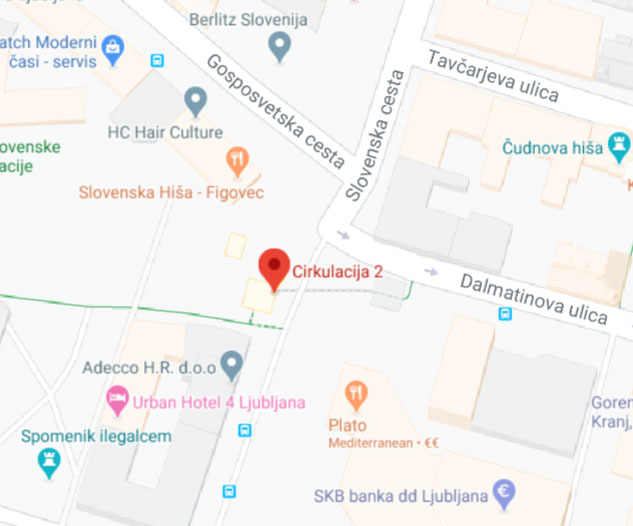
location: under the Fabiani bridge in Ljubljana
authors: Lina Rica, Marko Batista
The third edition of the Spatial Convergences platform approaches public space as an open-ended process — not as a stable entity, but as something continuously constituted through movement, time, and modes of presence. Public space is not simply a given environment that surrounds us; it is continually produced through the relations that emerge within it. Its identity is never definitive, but rather a temporary configuration of presences. In today’s technologically mediated environment, this process is increasingly intertwined with systems that no longer merely mediate between people and their surroundings, but are gradually becoming active in shaping how space is perceived, organised, and used.
Public space appears to be shared, yet its use is never entirely neutral or equally accessible. Every new presence temporarily alters it, reshaping patterns of use and relations between those who inhabit it. It is, above all, constituted through the practices that take place within it—through the everyday ways in which we move through and inhabit it. At the same time, as automated and intelligent systems become increasingly pervasive, the position of the human is also shifting: our actions are becoming ever more entangled with processes whose effects extend into the everyday ways we move, perceive, and make decisions. The project does not seek to resolve these tensions, but rather to bring them to the foreground through the experience of temporary inhabitation.
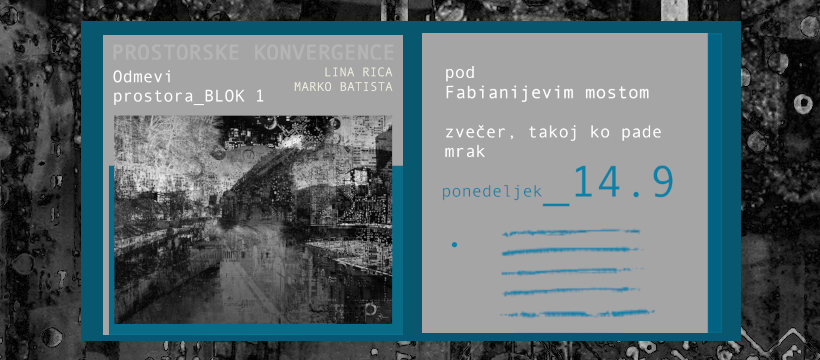
Echoes of Space_BLOK 1 brings together the experimental practices of intermedia artists Lina Rica and Marko Batista.
Through the temporary inhabitation of this site, they construct a temporal architecture — a configuration of relations between space, body, time, and technological processes that emerges, develops, reaches a point of intensity, and ultimately disappears. Lina Rico’s live-generated video mapping and Marko Batista’s experimental sound system establish a feedback loop between human, machine, and environment. Sound and image do not illustrate the surroundings; rather, they activate and transform them as a field of perception. The architecture of the underpass thus becomes, simultaneously, a physical structure, an acoustic resonator, a projection surface, and a temporary territory of shared presence. The audiovisual approach does not simply imply the combination of different media, but the creation of a situation in which technology becomes an active agent within the spatial process. The visitor is not positioned in front of a completed artwork, but enters a situation unfolding in real time — a site-specific, transdisciplinary process in which the architectural environment, human presence, and audiovisual systems converge, for a limited period, into a shared configuration.When the situation ends, the physical space remains unchanged, yet its static presence has been disrupted. It becomes a proposition that public space is not merely what it is, but also what it can become, even if only temporarily.